If you’ve ever walked through a metal fabrication plant, watched tiny fasteners click into place in a car engine, or held the hinge on a high-end kitchen cabinet, you’ve probably used parts made on a cold header. For years, I’ve supplied cold headers to manufacturers across automotive, aerospace, construction, and consumer electronics, and one question comes up constantly: why choose this process over traditional machining? The short answer is that it’s not just about speed—it’s about quality, cost, and consistency that no other metal forming method can match, especially for high-volume, precision parts. Let me break down what makes cold headers a game-changer, and why more manufacturers are switching to them every day. Cold Header
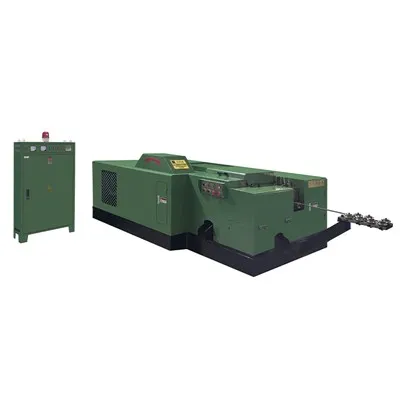
First, let’s clear up what a cold header actually does, because not everyone in production has this straight. Cold heading is a metal forming process that shapes wire or rod stock at room temperature, using extreme pressure to push the material into a die. Unlike hot forging, which heats metal to thousands of degrees to soften it before shaping, cold working works with the metal in its natural, unheated state. That might sound counterintuitive—how do you shape metal without heat? The answer is the unique strength of ductile metals like carbon steel, stainless steel, brass, and aluminum, which can deform at room temperature without cracking or breaking, as long as you apply controlled, targeted pressure. A cold header machine clamps the end of a straight wire blank, cuts it to the exact length, then uses a set of dies and punches to form it into the desired shape—think bolts, screws, rivets, pins, or specialized fasteners with complex heads, flanges, or grooves.
The biggest advantage of cold heading, by far, is material efficiency. Let’s do a quick math test to put this in perspective. Suppose you’re making a standard M10 bolt. If you use traditional machining, you start with a solid bar of steel that’s 10mm in diameter, drill and cut away all the extra metal to get the shank and head of the bolt. That means you’re wasting roughly 30% of the original material as metal shavings—scrap that you have to pay to recycle or dispose of. With cold heading, you use a wire blank that’s almost exactly the size of the final part: you only cut enough to make the bolt’s shank, then form the head by pushing metal into the die. There’s no wasteful cutting, no shavings, and almost every gram of the original wire becomes part of the finished bolt. For a high-volume manufacturer making 1 million bolts a month, that’s tens of thousands of dollars saved on material costs alone, not to mention the labor and energy used to machine away scrap. I’ve had a customer in the agricultural equipment space switch from machining to cold heading a line of anchor bolts, and they cut their material costs by 28% in the first six months. That’s not a small number for a business moving thousands of tons of steel every year.
Next, cold heading produces parts with far superior mechanical properties than machined parts, and that’s because of how the metal’s grain structure works. When you machine a part, you cut through the natural grain of the metal, leaving tiny weak points along the edges of the cut. Those points are where parts often crack or break under stress, especially in high-load applications like automotive drivetrains or aerospace components. With cold heading, the grain of the metal is compressed and shaped to follow the exact contour of the part—think of the grain of wood that runs along the length of a plank, vs. cutting it crosswise. The grain in a cold-formed bolt follows the curve of the head and the length of the shank, so there are no weak cut edges. That makes the part up to 25% stronger in tensile strength and fatigue resistance than a machined part of the same material and size. A customer of mine that makes fasteners for commercial aircraft recently tested cold-formed vs. machined pins for landing gear, and the cold-formed pins survived 40% more stress cycles before failing. That’s a safety difference that can’t be overstated, especially in industries where part failure isn’t an option.
Consistency is another huge win for cold heading, especially for high-volume production. A well-maintained cold header machine makes the same part, over and over, with tolerances measured in thousandths of an inch. Machining, while precise, can have small variations from part to part: tool wear, temperature fluctuations in the machine, even slight differences in how the operator loads the blank. Cold headers are automated, so once you set the dies and adjust the machine, every part comes out identical. For a manufacturer using parts in an assembly line, that consistency eliminates fit issues. If every bolt is exactly the same length and head size, you don’t have to adjust your assembly equipment for slight part variations, and you don’t have to sort through batches of parts to find ones that fit. I supply cold headers to a company that makes hinges for medical devices, where even a 0.001 inch variation in hinge pin diameter can cause a device to stick or fail during sterilization. Their cold-formed pins have a part-to-part variation of less than 0.0005 inches, which is impossible to achieve with standard machining without a lot of extra sorting and inspection time.
Speed is hard to beat too. A modern cold header can produce parts at a rate of 100 to 1,000 parts per minute, depending on the size and complexity of the part. That’s way faster than any machining process, even high-speed CNC centers. For small to medium-sized parts like screws, rivets, and pins, cold heading is almost unrivaled in volume. Think about it: a single cold header can make as many bolts in an hour as a CNC lathe can make in a full day. That means shorter lead times, faster order fulfillment, and lower labor costs per part. I had a customer that supplies fasteners to the construction industry, who used to order machined bolts and wait 2 weeks for a batch. Since switching to a cold header I supplied, they get the same batch of 50,000 bolts in 3 days, and the lead time for their customers dropped by 10 days. In construction, that kind of speed can make or beat a project timeline.
But cold heading isn’t just for simple fasteners, either. A lot of people think cold headers only make basic bolts, but modern machines can make extremely complex parts with multiple heads, internal grooves, flanges, and even pre-cision threads—all in one operation, in a single machine. That’s a huge advantage over processes that require multiple steps: for example, making a bolt with a hexagonal head and a threaded shank might need a lathe to cut the thread, a heat treater to harden it, and a grinder to finish the head. With a multi-station cold header, you can do all of that in one continuous process, with no need to move the part between machines, which saves time and reduces the chance of damage or error during handling. I recently helped a customer that makes custom fasteners for off-road vehicles design a multi-station cold header to make a specialized suspension pin that used to require 5 separate processes. They cut their production time per pin from 12 minutes to 45 seconds, and reduced defect rates from 4% to less than 0.5%.
Of course, no process is perfect, and cold heading does have limitations. It works best for small to medium-sized parts—usually under 2 inches in diameter, and up to about a foot long. For very large parts, like structural bolts for bridge construction, hot forging is usually more practical. It also works best for ductile metals; very hard materials like titanium alloys can be cold headed, but they require higher pressure and more specialized equipment, so the upfront cost is higher. But for the vast majority of parts manufacturers are making today—fasteners, pins, hinges, electrical connectors, small mechanical components—cold heading is the most efficient, high-quality option.
As a cold header supplier, I’ve seen firsthand how this process has evolved over the last decade. Modern cold headers are more automated, more precise, and more energy-efficient than ever before. Unlike hot forging, which requires furnaces that use huge amounts of energy to heat metal, cold heading operates at room temperature, so energy use is 70-80% lower than hot forming or machining. That’s not just good for your bottom line—it’s good for the environment, too. Less energy use means lower carbon emissions, and less material waste means fewer raw resources pulled from the ground. For manufacturers that are working to meet sustainability goals, cold heading is a clear choice.
If you’re currently machining parts that are used in high volumes, or if you’re dealing with part failure issues, high scrap rates, or long lead times, cold heading is worth a closer look. I’ve worked with manufacturers of all sizes, from small job shops to large multinational corporations, to evaluate their part designs, recommend the right cold header setup, and even help adjust part designs to take full advantage of the process’s capabilities. There’s no one-size-fits-all solution for metal forming, but for most high-volume, precision metal parts, cold heading delivers better quality, lower costs, and faster production than any alternative.

If you’re ready to learn more about how cold heading can improve your operations, or if you’re looking to upgrade or add a cold header to your production line, reach out to my team for a no-obligation consultation. We can walk through your part requirements, compare processes, and help you find a solution that fits your production needs and budget. The difference that cold heading can make for your bottom line and your product quality is often bigger than you think.
Nut Former Machine References
- Dickerson, R. (2018). Metal Forming: Fundamentals and Applications. ASM International.
- Groover, M. P. (2020). Fundamentals of Modern Manufacturing: Materials, Processes, and Systems. John Wiley & Sons.
- American Iron and Steel Institute. (2021). “Advances in Cold Heading Technology for High-Volume Fastener Production.” Steel Industry Technology Report.
- Tschätsch, H. (2019). Cold Forging Science and Technology. Springer.
- Aerospace Industries Association. (2022). “Materials and Process Specifications for Cold-Formed Fasteners.” AIA Technical Bulletin.
Wenzhou Rayliter Industrial Co., Ltd.
As one of the leading cold header manufacturers and suppliers in China, we also support customized service. We warmly welcome you to buy advanced cold header made in China here from our factory. For quotation, contact us now.
Address: 2nd Floor, Building 3, Aoshi Furniture, No. 1001 Kunbei Road, Lingkun Street, Dongtou District, Wenzhou City, Zhejiang Province
E-mail: Rayliter@163.com
WebSite: https://www.rayliter-tech.com/
